

 Data Centers: Powering Today's Digital World and Tomorrow's AI Revolution
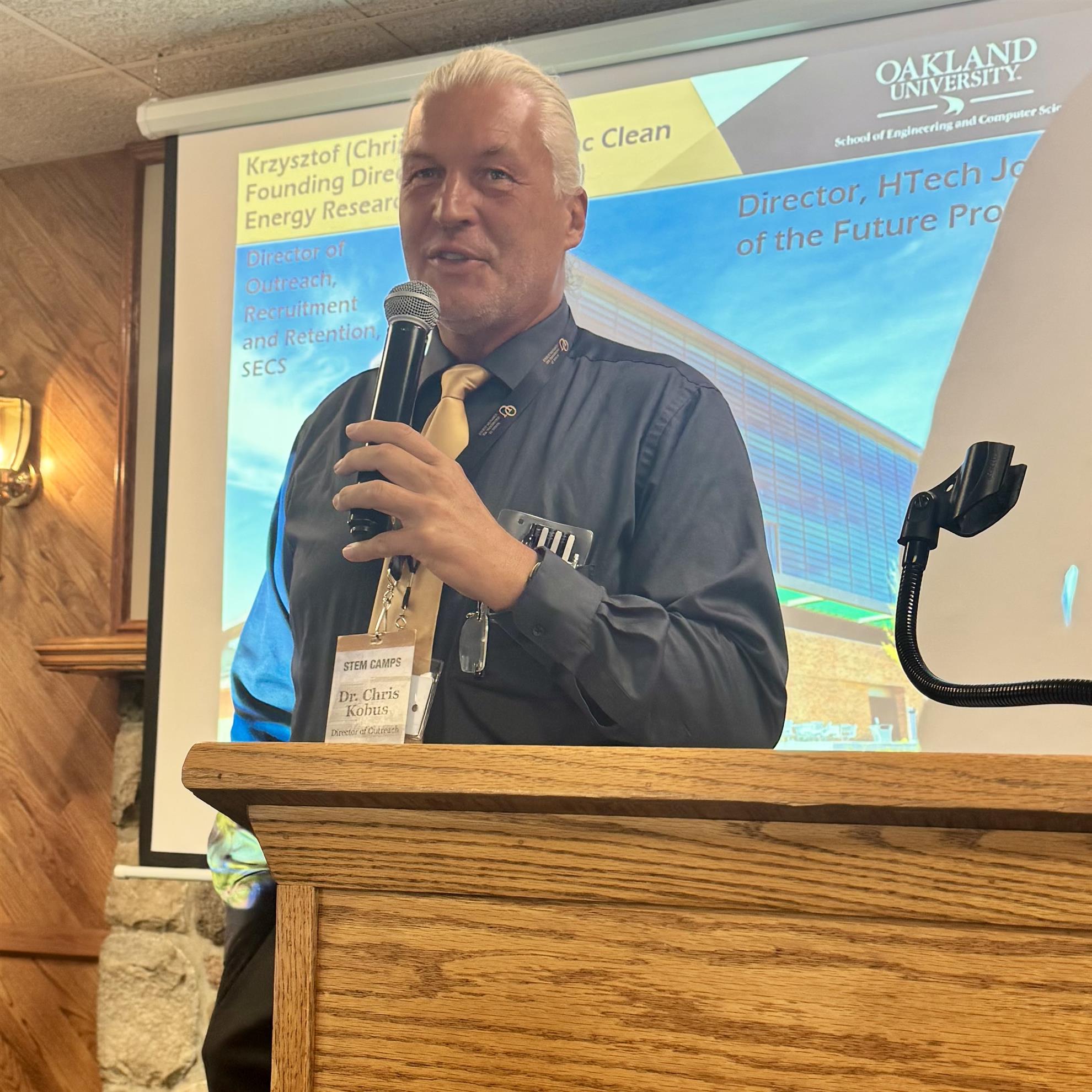
Rotarians welcomed Dr. Chris Kobus, Professor of Mechanical Engineering in Oakland University's School of Engineering and Computer Science, Founding Director of the Oakland University Clean Energy Research Center (CERC), and Director of the Hi Tech Jobs of the Future Program, for an informative presentation on data centers and Oakland University's proposed public-private data center project.
Although data centers have become a hot topic in recent months, Dr. Kobus noted that they are far from new. Michigan has housed data centers for decades. What has changed is the explosive demand for digital services—and the rapid growth of artificial intelligence (AI).
The Digital Infrastructure We Depend On
To illustrate how integral data centers have become, Dr. Kobus asked the audience a few simple questions: Who owns a smartphone? Who streams movies? Shops online? Uses social media? Searches the internet?
Nearly every hand in the room went up.
"Every app on your phone, every Google search, every movie you stream, every Amazon purchase depends on a data center," he explained. "We're the ones driving the demand."
As technology continues to advance—from 4K and larger televisions to faster internet speeds and increasingly sophisticated mobile devices—the need for computing power continues to grow.
AI: The Next Great Technological Revolution
Dr. Kobus believes artificial intelligence represents the next "once-in-a-generation" technological transformation, comparing it to the expansion of railroads in the 1800s, electrification in the early 1900s, the interstate highway system in the 1960s, and the rise of the internet in the 1990s.
Unlike previous technology booms fueled by speculation, today's investment in AI is being financed by record profits generated by companies such as Apple, Amazon, Google, Microsoft, Meta, NVIDIA, and others.
These companies are investing hundreds of billions of dollars in new computing infrastructure because the demand is already here—and growing rapidly.
Data centers, he explained, are essentially facilities filled with high-performance computers that store, process, and distribute enormous amounts of digital information. They provide cloud computing services, support AI applications, and make the digital economy possible.
Addressing Environmental Concerns
Dr. Kobus acknowledged that concerns about energy use, water consumption, and noise are frequently raised whenever new data centers are proposed. However, he emphasized that many public discussions are based on outdated information.
Modern data centers, he explained, increasingly use closed-loop cooling systems that recycle water rather than continuously consuming fresh water. New chip technology is also dramatically reducing cooling requirements, with companies like NVIDIA developing processors that operate at much higher temperatures and require significantly less cooling.
Noise concerns, he noted, generally come not from the computer servers themselves but from external cooling equipment and backup power systems—equipment commonly found at many industrial facilities.
Like many industries, data centers continue to become more efficient as technology advances.
Benefits Beyond the Building
According to Dr. Kobus, communities often benefit when data centers are built. Electrical infrastructure and internet connectivity are frequently upgraded to support the facilities, resulting in improved reliability for nearby residents and businesses.
He also noted that the facilities create partnerships with universities and local schools while strengthening regional technology infrastructure.
Oakland University's Proposal
Dr. Kobus shared details about Oakland University's proposed data center project, which would be a public-private partnership.
The university already has electrical infrastructure capable of supporting a 26-megawatt facility, meaning significant new power infrastructure would not be required. Oakland University would utilize approximately three megawatts of computing capacity—roughly ten times more than its existing data centers currently provide—while the private company would operate and maintain the remaining capacity for commercial customers.
The arrangement would allow the university to replace aging computer infrastructure without bearing the cost of continual technology upgrades while providing faculty and students with access to state-of-the-art computing resources for research.
Dr. Kobus compared the proposal to Oakland University's decision in 2012 to move its email system to Google, allowing the university to benefit from continuously updated technology rather than maintaining its own aging servers.
Looking Ahead
Perhaps the most thought-provoking part of the presentation focused on AI's future impact.
Within the next decade or two, Dr. Kobus envisions autonomous vehicles capable of driving passengers across the country with little or no human intervention. He also predicted that AI will revolutionize healthcare through continuous monitoring technologies capable of identifying diseases long before symptoms appear, dramatically improving preventive medicine.
Throughout his presentation, Dr. Kobus encouraged attendees to view data centers not simply as large buildings filled with computers, but as the critical infrastructure supporting today's digital economy and enabling tomorrow's technological breakthroughs. Whether powering online shopping, cloud computing, medical advances, or artificial intelligence, data centers will continue to play an increasingly important role in everyday life.